
08/08/2026
A brand's digital identity is fully signed off. Yet, the same gap appears on almost every new project that Exprintmart, a large-format printing and signage company that has produced branded environments across Dubai for over two decades, works on: the moment that identity has to survive a Dubai Municipality inspection, a Pantone-to-vinyl color match, or a bilingual signage requirement, no one on the client's team has an answer ready.
That gap is not a design failure. It is what happens when brand consistency is treated as a marketing checklist instead of a production discipline. A logo file looks the same on every screen it's opened on; RGB is RGB. The moment that same brand steps off a screen and onto a shopfront, a vehicle wrap in Dubai, or an exhibition stand at the Dubai World Trade Centre, it has to survive a completely different set of rules: regulatory, material, and optical.
Few marketing teams realize that color itself is not a fixed thing once it leaves a screen. Digital brand assets are built in RGB; most large-format print output is CMYK or matched to a physical Pantone or RAL swatch. Move a brand's signature blue from an Instagram feed to vinyl signage, powder-coated aluminum, or a printed banner without a color-matched reference, and it will noticeably drift, sometimes enough that a returning customer registers the shopfront as “off” without knowing why.
A consistent brand experience in the market depends on a Pantone color-matched reference being locked into the brand guideline from day one and every print vendor-signage, packaging, and event graphics working from that same swatch rather than eyeballing a screenshot. It's a small production detail with an outsized effect on whether a brand actually looks like one brand.
A brand touchpoint is any moment a customer interacts with a business, directly or indirectly. In the UAE's mobile-first, multicultural market, that list is longer than most companies realize, and it spans two very different worlds:
Industry research on UAE consumer behavior points to a consistent pattern: shoppers typically move across five to eight of these touchpoints before they commit to a brand, switching from a social feed to a search engine to an in-person visit within a single decision. Every switch is a chance to reinforce the brand or quietly undermine it.
Physical branding in Dubai isn't just a design exercise; it's a compliance one. Exterior signage typically needs sign-off from Dubai Municipality, the Department of Economic Development, or Trakhees for free-zone premises, depending on location. In contrast, roadside and highway-facing signage additionally falls under RTA review. The business name on the sign has to match the trade license exactly, signage content is generally required to appear in Arabic alongside English, and larger or free-standing structures need structural wind-load certification before they're approved for installation.
None of that is optional, and none of it is something a purely digital brand guideline anticipates. A consistent brand experience strategy that stops at typography and color codes, without a plan for how the brand survives a bilingual layout requirement or a municipality material restriction, will hit friction the first time it meets a permit officer rather than a customer.
Inconsistency rarely announces itself as one dramatic failure. It shows up as small mismatches: a website that promises premium service next to a reception desk with a faded, outdated banner; an Instagram feed in bold modern typography beside a shopfront sign in a completely different font; a support agent who doesn't sound like the brand's confident social media voice.
Each mismatch is minor on its own, but together they erode brand trust. Dubai's buyers are sophisticated and have abundant choice; when a business can't keep its own story straight, customers assume the product or service will be just as inconsistent. Brand consistency is what turns a one-time buyer into a repeat customer: familiarity, the same look, tone, and quality encountered again and again, is what builds recognition, and recognition is what builds trust.
Most businesses invest heavily in getting their digital presence right and treat physical execution as an afterthought. That gap is exactly where a consistent brand experience tends to break down. The table below maps where the disconnect typically happens and what closing it looks like.
| Touchpoint Type | Common Weak Point | What Consistency Looks Like |
|---|---|---|
| Website & social media | Frequent updates made with no reference to brand guidelines | Same color codes, tone of voice, and imagery style on every post and page |
| Signage & storefronts | Color drifts from screen to vinyl; bilingual layout treated as an afterthought | Pantone-matched color, Arabic- and English-sized per regulation, logo usage identical to digital assets |
| Packaging & printed collateral | Ordered from different vendors with slightly different color output | One approved print partner working from a single brand file and color reference across all materials |
| Events & exhibitions | Treated as one-off projects with custom, off-brand visuals | Booth graphics, banners, and giveaways built from the same guidelines as the website |
| Customer service | The scripted tone differs from the brand's public voice. | Support tone mirrors the brand's written and visual personality. |
Closing that gap isn't about a single campaign; it's about a system. Businesses that manage customer touchpoints well tend to get five things right.
Logo usage, color codes with a locked Pantone or RAL reference, typography, tone of voice, and imagery style should live in one document that marketing, sales, HR, and every external vendor can reference, not in someone's memory.
Whether a customer reads a LinkedIn post or a WhatsApp reply, the personality behind the words should feel identical: the same level of formality, the same vocabulary, the same warmth.
Marketing, sales, and operations are usually the three teams a customer interacts with, and they are often the least coordinated internally. Shared guidelines and regular check-ins keep the customer journey feeling like one continuous conversation instead of three different companies.
A CRM or omnichannel platform that logs interactions across WhatsApp, email, and in-store visits lets a business pick up a conversation where the customer left it, a small operational detail with an outsized effect on perceived consistency.
This is the step most businesses underestimate. A brand can have a flawless website and still lose credibility the moment a customer walks into a showroom with mismatched signage, or receives event collateral that looks like it belongs to a different company, and a signage project that stalls in the municipality approval queue because material specs or bilingual layout weren't planned for, costing weeks a rebrand rarely has to spare.
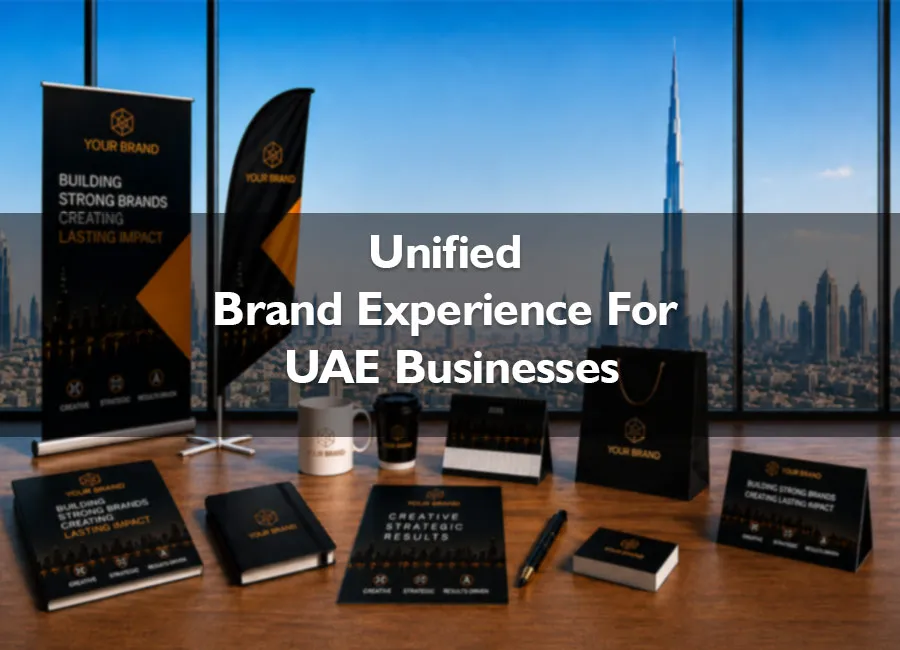
A style guide only proves its worth when it survives contact with the real world, printed on a shopfront sign, wrapped around a vehicle, mounted at an exhibition stand, or handed over as a branded gift box. This is where many UAE businesses lose consistency without realizing it: the guidelines are correct, the Pantone reference is locked, but execution across signage, packaging, and event branding is split across different vendors, each interpreting the brand file and each navigating permits and materials slightly differently.
Consolidating that execution under a single production partner removes this variable: one brand file, one color reference, and one team familiar with Dubai Municipality, DED, and RTA signage requirements, handling everything from office branding and vehicle wraps to exhibition stands and packaging. One production standard means every physical touchpoint matches the digital one, which is ultimately what consistent brand experience comes down to: not one perfect channel, but no weak links, and no compliance surprises between any of them.
Founder & Print Industry Expert - 12+ Years in UAE Printing Solutions
Visit Us: 13th St - Al Qusais Industrial Area 2 Dubai - United Arab Emirates
Call: +971 56 931 7076
Email: info@exprintmart.com
Couldn't find what you are looking for?
We can customize as per your requirements.Contact Us
Exprintmart - Printing Company in Dubai | © 2014-2026 All Rights Reserved
All website content, including text, images, and designs, is protected under applicable copyright laws. Unauthorized use is strictly prohibited.
Exprintmart is a leading printing and branding company in Dubai, UAE, offering backdrops, flags, business cards, brochures, signage, exhibition displays, and corporate printing solutions.we serve high-quality printing services across the UAE with urgent delivery option.
info@exprintmart.com
+971 56 931 7076
Exprintmart website is owned and operated by
Deluxe Digital Advertising LLC
Media License Number: 1970641